
Few names come up as often in conversations about out-of-body experiences as Robert Monroe. Here is who he was, what he wrote, and where his own reports end and the research begins.
Robert Monroe (1915 to 1995) was an American radio writer and producer who published Journeys Out of the Body in 1971, a first-person account of experiences he described as leaving his body. He is also associated with Hemi-Sync®, an audio method. His accounts are personal reports, and research on binaural beats in general is limited, so it is best to read his claims with curiosity, not as proof.
Who Was Robert Monroe?
Robert Monroe (1915 to 1995) was an American radio writer, producer and station owner who later turned to consciousness research. In 1971 he published Journeys Out of the Body, a first-person account of experiences he described as leaving his physical body. He is also associated with Hemi-Sync®, an audio method he patented.
According to the Psi Encyclopedia of the Society for Psychical Research, he worked in radio for many years, writing and producing programs, owning stations and adopting magnetic tape early. That encyclopedia treats parapsychology as a subject of study, so it is worth reading with that in mind.
| Year | Milestone | Details |
|---|---|---|
| 1971 | Journeys Out of the Body | His first book, published by Doubleday |
| 1975 | First Hemi-Sync® patent | The first of several patents for audio techniques |
| 1985 | Far Journeys | His second book |
| 1994 | Ultimate Journey | His third book |
What Is Journeys Out of the Body?
Journeys Out of the Body, published by Doubleday in 1971, is Robert Monroe's first-person account of experiences he described as leaving his physical body. He presented them as his own reports, not as laboratory findings. He followed it with Far Journeys in 1985 and Ultimate Journey in 1994.
It helps to read the book for what it is: a personal account. When Monroe described an experience, that is what he reported, and it is not something science has confirmed. If you want to compare these ideas with lucid dreaming, see our guide to lucid dreaming vs astral projection. And if you are curious about the moments at the edge of sleep, where many such experiences are said to begin, read about hypnagogia.
What Is Hemi-Sync®?
Hemi-Sync®, short for hemispheric synchronization, is an audio method developed by Robert Monroe that is generally described as using binaural beats, which are two slightly different tones played separately to each ear. Monroe received the first of several patents for it in 1975. It is described as a way to support self-directed exploration of focused states of consciousness, which is a description of the method, not an established result.
Hemi-Sync® is the name The Monroe Institute uses for its audio method. If you try any audio like this, listen earlier in the evening, and keep your phone away from the bed.
What Does Research Say About Binaural Beats?
Research on binaural beats in general is limited and mixed in scope. A 2019 meta-analysis of 22 studies found an overall medium effect (g = 0.45) across memory and attention, anxiety and pain perception. It did not study out-of-body experiences, and it examined binaural beats, not Hemi-Sync® specifically.
That is the honest limit of what we can say here. The meta-analysis (Garcia-Argibay, Santed and Reales, 2019) pooled 35 effect sizes, and the summary we read does not describe the quality of the studies it included. It does not show that binaural beats, or Hemi-Sync®, work for out-of-body experiences, sleep or meditation.
What Is The Monroe Institute?
The Monroe Institute is a nonprofit organization based in Faber, Virginia, that offers programs such as Gateway, which introduces participants to inner exploration step by step. Sources differ on when it was founded, so we leave the date out. This article describes it only as an organization and does not endorse any program.
Keeping Notes on What You Experience
If you listen to audio like this, meditate, or have unusual experiences around sleep, it helps to write down what happened soon afterward, in a few plain words, and to record how you felt. Over time you may notice patterns, and you can compare your notes without relying on memory.
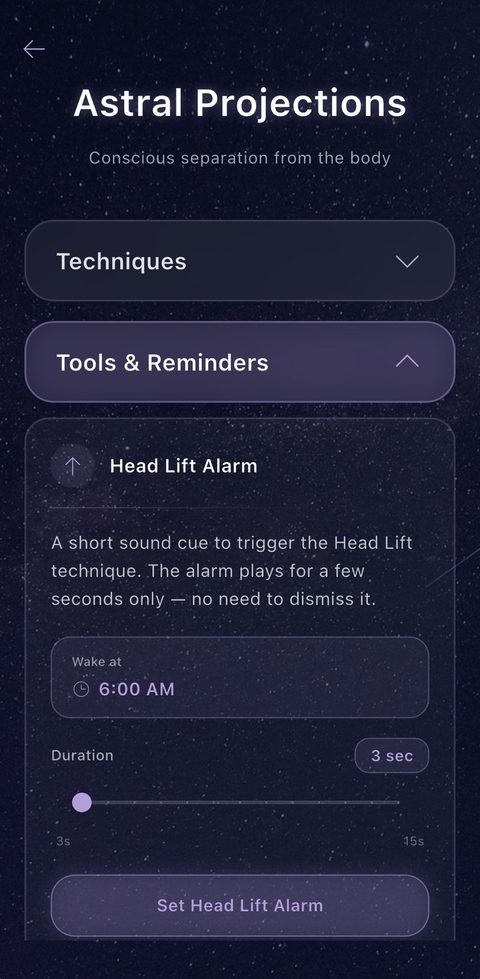
RealAwake on iPhone has entry types for Dreams, Lucid Dreams, Astral Projections, Meditation and Contemplation, and you can type your entry or dictate it. Our guide to how to keep a lucid dream journal covers simple habits, and you can see how the RealAwake dream journal works.

Want a grounded place to start?
The free Lucid Dreaming Starter Guide walks you through recording your dreams and the techniques people try, with honest expectations.
Get the Free Guide →Sources
- Psi Encyclopedia, Society for Psychical Research. Robert Monroe.
- Encyclopedia.com. The Monroe Institute.
- Garcia-Argibay, M., Santed, M. A., & Reales, J. M. (2019). Efficacy of binaural auditory beats in cognition, anxiety, and pain perception: a meta-analysis. Psychological Research, 83(2), 357-372.
Write it down before it slips away
Whatever you experience, a few words written soon afterward are easier to trust than a memory a week later. RealAwake is free on the App Store for iPhone.
See the app →