
Just as you start to drift off, the room fades and something else takes over: a shape, a sound, a thought that doesn't quite make sense. That in-between moment has a name, and it is more common than most people think.
Hypnagogia is the transitional state between being awake and falling asleep. Some people notice images, sounds or sensations during it, and sleep researchers describe these experiences as fairly common. It connects to dream recall and lucid dreaming, and a quick note can help you keep what you noticed.
What Is Hypnagogia?
Hypnagogia is the transitional state between being awake and falling asleep. During it, some people notice images, sounds or bodily sensations as their thoughts begin to loosen. Sleep researchers associate it with an early stage of non-REM sleep, and brief experiences like these are generally considered a normal part of falling asleep.
You will also see it called the hypnagogic state. The National Institutes of Health notes that this period is sometimes called sleep onset, hypnagogia or N1 sleep, and describes it as a twilight state between wakefulness and sleep.
What Do People Report?
Reports vary a lot from person to person. Some people describe shapes, colors or patterns behind closed eyes. Others describe faint sounds or voices, a feeling of falling or swaying, or thoughts that start to slip away from logic. Many people never notice any of it, and that is normal too.
One well-known example comes from a 2000 study in Science (Stickgold and colleagues). People who played Tetris for hours reported seeing the falling blocks as they fell asleep. Three people with severe memory loss, who could not remember playing, described similar images, which suggests these images can arise with little help from ordinary memory. It was a small study, so treat it as an illustration, not a rule.
Because these moments are brief, they are easy to lose. That is part of why they are interesting to anyone who keeps a dream journal.
Are Hypnagogic Hallucinations Normal?
Hypnagogic hallucinations are sensory experiences that happen while you fall asleep, such as seeing shapes, hearing sounds or feeling movement. According to the Sleep Foundation, up to 37% of people report them. The same source describes the closely related hypnopompic kind as generally harmless and normal, and advises that if hallucinations interfere with your sleep or cause you distress, you consider seeking medical attention.
A 1996 telephone survey of 4,972 people in the United Kingdom (Ohayon and colleagues) found similar numbers: 37% reported hypnagogic hallucinations and 12.5% hypnopompic ones, and the authors described them as much more common than expected. It was a self-reported survey, so the figures are estimates.
The American Academy of Sleep Medicine notes that vivid hallucinations at sleep onset and sleep paralysis, a brief episode of being unable to move or speak as you fall asleep or wake up, are seen in narcolepsy, but can also occur in people who sleep normally and in people with other sleep disorders. If they are frequent or bother you, that is one more reason to talk to a doctor.
This article is general information, not medical advice. If something worries you, or it happens often and disrupts your sleep, talk to a doctor.
Hypnagogic vs Hypnopompic: What Is the Difference?
Hypnagogic experiences happen while you fall asleep, and hypnopompic ones happen while you wake up. Together they are called hypnagogia, and both likely arise in an early non-REM sleep stage. The Sleep Foundation reports hypnagogic hallucinations in up to 37% of people and hypnopompic ones in over 12%.
| Feature | Hypnagogic | Hypnopompic |
|---|---|---|
| When it happens | As you fall asleep | As you wake up |
| How common (Sleep Foundation) | Up to 37% of people | Over 12% of people |
| What people describe | Shapes, sounds or a sense of movement | Similar sensory experiences, as you wake |
What are hypnopompic hallucinations?
Hypnopompic hallucinations are sensory experiences that happen as you wake up, for example seeing a shape or hearing a sound that is not there. The Sleep Foundation reports them in over 12% of people and describes them as generally harmless and normal. The same advice applies: if they interfere with your sleep or cause you distress, consider seeking medical attention.
Hypnagogia and Lucid Dreaming
Hypnagogia matters to lucid dreamers because it is the doorway into sleep. Some practitioners try to stay aware as the body falls asleep, which is the idea behind WILD, a lucid dream entered directly from waking. You can read more in our guides to what lucid dreaming is and how to lucid dream.
It is worth staying realistic. A 2012 systematic review by Stumbrys and colleagues concluded that no induction technique had been verified reliably and consistently, although some looked promising. Paying attention to hypnagogia may be one way to explore, but it is not a guarantee of a lucid dream.
Edison, Dalí and the falling object
The story goes that Thomas Edison and Salvador Dalí napped while holding a heavy object, so that it would drop and wake them as they drifted off, in order to catch ideas from the earliest moments of sleep. The NIH says they were reportedly among those who recognized the importance of this stage, so treat it as a historical account, not a proven method.
Researchers have looked at the idea. A 2023 study in Scientific Reports (Horowitz and colleagues, 49 healthy adults) found that guiding people toward a theme as they fell asleep was followed by better results on a creativity task. It is a small study, so it is a reason to be curious, not a promise.
A 2021 study in Science Advances (Lacaux and colleagues, 103 people) tested a similar setup: after a 20-minute nap holding an object, people who spent at least 15 seconds in the first stage of sleep were about three times more likely to find a hidden rule in a maths task. The effect disappeared in people who fell into deeper sleep. It does not prove the Edison and Dalí story, but it shows the idea can be studied.
How to Record Hypnagogic Experiences
You do not need anything fancy. As soon as you are awake enough, write down what you noticed, even in a few words: an image, a sound, a feeling, a thought. Writing it down helps you remember it, and over time you may start to see patterns in what you experience.
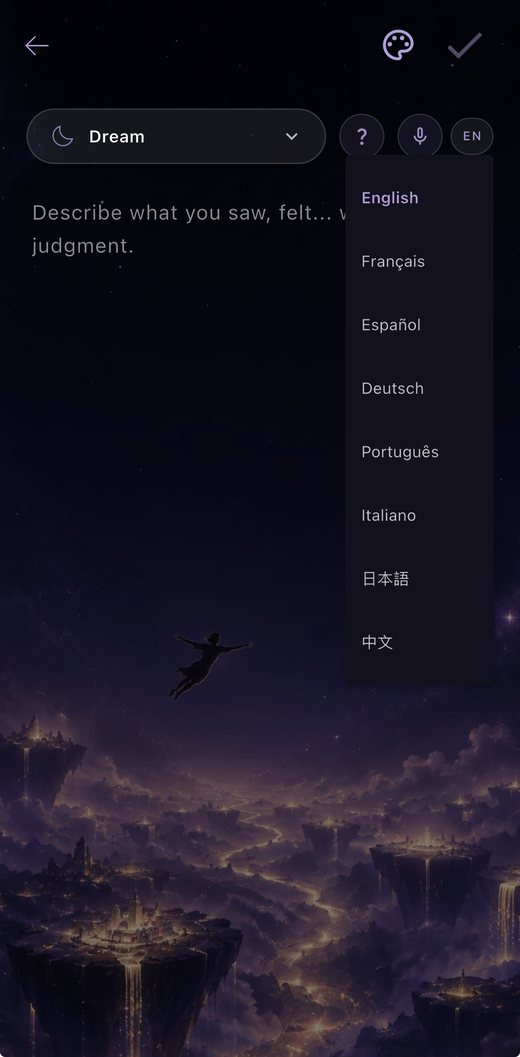
In RealAwake on iPhone, you can type your entry or tap the microphone and dictate it. Our guides on how to remember your dreams and how to keep a lucid dream journal cover simple habits that work just as well for these short moments. You can also see how the RealAwake dream journal works.

Curious where this can lead?
The free Lucid Dreaming Starter Guide shows how recording what you notice, from dreams to the moments around them, can become the base for lucid dreaming.
Get the Free Guide →Questions About Hypnagogia
Is hypnagogia the same as dreaming?
Not exactly. Hypnagogia is the transition into sleep, and what you notice in it can feel dreamlike. Researchers describe it as a twilight state between waking and sleep, and whether a particular experience counts as dreaming depends on how you define the word.
What does hypnagogic imagery look like?
People describe a wide range: shapes, patterns, colors, faces or short scenes, and sometimes sounds or a feeling of movement. It varies a lot between people, and some never notice it at all.
Sources
- Sleep Foundation. Hypnopompic Hallucinations.
- National Institutes of Health, NIH Research Matters. Quick catnaps may spark creativity.
- Ohayon, M. M., Priest, R. G., Caulet, M., & Guilleminault, C. (1996). Hypnagogic and hypnopompic hallucinations: pathological phenomena? The British Journal of Psychiatry, 169(4).
- American Academy of Sleep Medicine. Narcolepsy fact sheet.
- Stickgold, R., Malia, A., Maguire, D., Roddenberry, D., & O'Connor, M. (2000). Replaying the game: Hypnagogic images in normals and amnesics. Science, 290(5490).
- Horowitz, A. H., et al. (2023). Targeted dream incubation at sleep onset increases post-sleep creative performance. Scientific Reports, 13, 7319.
- Lacaux, C., et al. (2021). Science Advances. Summarized in Inserm's press release, "Does falling asleep boost creativity?"
- Stumbrys, T., Erlacher, D., Schädlich, M., & Schredl, M. (2012). Induction of lucid dreams: A systematic review of evidence. Consciousness and Cognition, 21(3), 1456-1475.
Catch it before it slips away
Those in-between moments are short and easy to lose. RealAwake lets you type or dictate a few words as soon as you are awake enough, and it is free on the App Store for iPhone.
See the app →